
By Manuel Nüesch.
Artificial Intelligence (AI) the solution of all our problems, at least in relation to the mass media. According to current news articles AI is conquering research fields one by one, leading to ever new solutions. AI can learn from data and come to solutions that are not reproduceable by humans. How long will it take until AI is capable of coding itself and acting like a human being, influencing our daily lives in unforeseen ways?
(Jirsak/Shutterstock.com)
In reality, AI is already all over the place in our daily business and it’s not even close to what is described above. It helps us chose what movie to watch or what search result on google are more accurate or interesting than others, but it is always just one specific AI model for each case. The artificial intelligence has not yet achieved the capabilities to be used for any functionality.
Let’s take a deeper look in what exactly AI is. In general AI is just a research area that is composed of different disciplines like Philosophy, Mathematics, Neuroscience, Psychology and Computer Engineering. The idea to create a machine that is capable of fulfilling tasks like a human is already several decades old. The theory behind the different AI techniques used today is dated back to that time as well. There has not been a lot of change in this theory since the 60s. The progress made in this research area are mainly to explain due to the progress of the technology. The computation power has increased drastically the last years. Therefore, more complex models can be calculated and trained to. These AI models are just like regulations for the computer and have nothing to do with human intelligence. Even though in articles it is mentioned that the AI has learned to distinguish a pattern it is not the same learning as you experienced during your school years. The AI model uses probabilities and rules to select classes for each pattern given. These rules are unique but in the end are just guidelines that work in one specific environment.
In general AI is separated in two groups called Artificial General Intelligence (AGI) and Artificial Narrow Intelligence (ANI). Every current or past AI model is classified as ANI. This means, as mentioned before, the Model only works for one specific case. AGI on the other hand can act like a human, make decisions by themselves, learn skills of off Instructions without any Human interference and so forth. But AGI is still just a prediction/dream.
The different AI techniques can be categorised. Machine learning is a subcategory of AI and uses probabilistics to make a prediction or decision. The next subcategory is deep learning which is hierarchically part of machine learning and supports the usage of Artificial Neuronal Networks (ANN). ANN were developed with the idea to simulate the human brain with a computer. Nowadays we know that the ANN are not even close to the capacity of our brain, but they help to find solutions for logical problems which our brain struggles with.
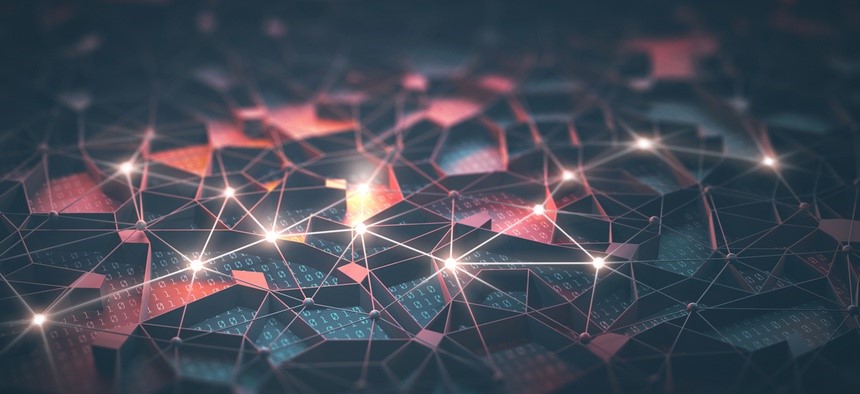
(ktsdesign/Shutterstock.com)
ANN are a network of nots with different layers that transform the input into a desired output. The network creates the rules for this transformation by itself, based on training data. There are three different ways of training a model: supervised, unsupervised and reinforced. Supervised learning means the machine has access to the data and the corresponding results. From those inputs it can calculate the rules that lead from one to another. Unsupervised learning means the data is given to a model and the model tries to find similarities and create clusters which might reveal connections within the data. The third training technique is reinforcement learning. The machine gets feedback during the training process and if it produces a correct result it gets rewarded and thereby follows a certain direction. In the end, no matter which training technique is applied, it is unclear how the AI came to that conclusion. Even reproducing an exact result with the same AI trained with the same method is not possible. Each training changes the model differently every time even if you use the same data.
Since AI is based on logical solutions scientists were able to discover correlations or connections that were hard to find before. The training can be done as well by another machine and the rules established to achieve the result are therefore not influenced by humans and should be objective. That would be ideal in the current generation where we fight for equality between all races and genders. Sadly, this is not the case. The data itself is influenced by human behavior anyway. For example, we create a model that reviews CVs. The training is done by data of humans choosing and hiring candidates. If this person that did the recruiting is biased (which is always the case) the data that is used to train the model is biased as well and therefore the created model will be influenced by humans. The machine has no other choice than to adapt it. It cannot know better. It is possible to adjust the model to a known bias, but it is likely to make the model less efficient and efficiency is what corporations look for. Obviously ethically it’s not correct to allow these biases to exist.
This is a big problem for the use of AI and shown in many movies where the AGI turns against its creators after analysing the human behavior. This is just science fiction, but it bears some truth.
Even though we call AI to be intelligent it can only do what it is told. It can create rules to achieve results that are correct and open new doors that we were not able to unlock or did not even see before. It is not capable of changing its behavior by itself. Do not be afraid of AI it is not at a point where it is capable of turning against us.

(sdecoret/Shutterstock.com)
 FoodArchitecture