By Geiger Philippe.
How a Space Monkey, Marshmallow, Spaghetti and an IT School for refugees are related when it comes to Digital Transformation
Digital Transformation was the title of the first morning at the Master Module “Digital Food Business” at the ZHAW. I thought, that sounds like it could be pretty much everything. I expected everything but was still surprised what I have learned in these following few hours. I wouldn’t have imagined, that playing with Spaghetti and Marshmallow would help me to understand more about leadership and using a Space Monkey would lead me to develop an App idea in only 30 minutes. Anyway, how is all this connected to Digital Food Business?
Let’s start from the beginning.
Social Entrepreneurship: ReDI School shows how educating refugees can change lifes and help the economy at the same time
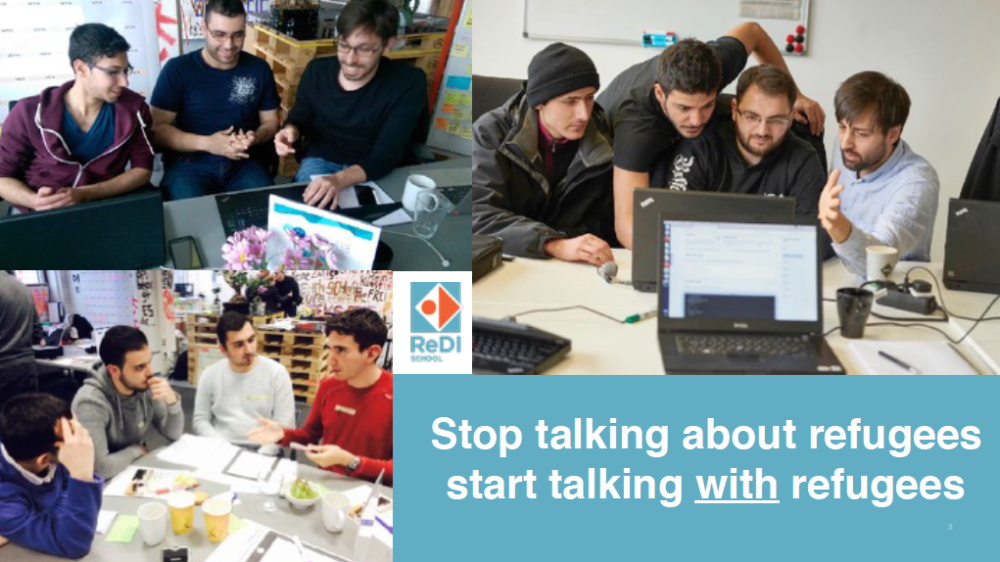
Anne Kjaer Riechert, CEO and Founder of ReDI School gave us some insights about social Entrepreneurship and the challenges, which are related to it. So, what does that have to do with our topic? Well, you could call refugees also experts in transformation. They left their home because of different crisis and took a long and dangerous path to get to Europe. In this case to Germany. From being comfortable at the place where you grow up with your family to being alone in a foreign country is a huge transformation. They are often well-educated and smart people but still, finding work in Germany seems mostly impossible since they have no network and often don’t speak german when arriving there. ReDI School provides free IT-education to refugees and in order to make that possible works together with different global IT players. This enables talented refugees to develop their IT skills, get direct contact with companies, which are seeking skilled IT talents and therefore improve their possibility to get a job. I will not get into detail about the School itself but I can highly recommend to look on their Website where you can learn more about the great work they do every day.
What Spaghetti and Marshmallow can teach us?
The next point on our agenda was a group work. We were given the task to build the tallest freestanding structure out of 20 sticks of spaghetti, 1m of tape, 1m of string, and 1 marshmallow in 18 minutes time. The marshmallow had to be placed on the top of the structure. Anne also highlighted that the team, which reaches 1 meter of height, would get a special price. Therefore, of course we aimed for no less than a one-meter tall sculpture. Making a long story short: We failed miserably and with us all the other teams too. All the sculptures were not able to stand or broke down after a very short time. Why didn’t it work? Well, to build a 1m tall sculpture with the given materials is almost impossible. If we wouldn’t have had the goal of such a tall sculpture we would have aimed for less and the results might have been better. This task is already quite popular and was given to different groups all over the world. In general children performed the best. They just didn’t think too much about possible solutions and whether this might work. They just tried it out – step by step. If they managed to stabilize a sculpture, they tried to build a higher one until they reached the tallest sculpture possible. Making small steps often leads to better solutions rather than trying to reach the sky with the first try.
That leads us to the next topic: creating space monkeys

Space Monkeys to develop a new App idea
When we want to try new things, we might first like to test it. This is called prototyping or speaking in a less technical way: creating a space monkey.

(Quelle: https://www.redbubble.com/de/people/authentik/works/21757775-space-monkey?p=art-print)
As resources of all kinds are often quite limited, ideas need to be realized on a smaller scale. Going back to the story of Anne and ReDI School we got a nice example of how that works in reality.
Anne had a conversation with a refugee who was afraid to lose his programming skills because he had no laptop to use was therefore not able to keep himself up to date. At the same time, she had a friend who liked to teach people his IT skills. Therefore, she had the simple but great idea to bring them together and could soon inspire more to join. After each class the group grew bigger. Together they made mistakes and though they were able to learn fast until today. They still work with the same mindset.
With that in our mind we were given another task.
We used a template to develop an App idea, which should tackle the question: “How might we get children to eat healthier?”
In 20 minutes time ideas where created and after a first feedback within the participants further developed. This example showed how a first prototype could be created, validated and then further developed in a very short time. An improvement could be made after each round of feedback. In this manner, it is possible to start with a small idea, create space monkeys and grow the idea systematically.
I was impressed how good ideas could be developed in a short period of time.
Further, the task made clear why ReDI School might be successful in the future: Being mostly food engineers we had good ideas on how an App could look like and how it should work. But none of us is skilled in programming. All our App ideas can’t be transformed into reality without skilled people who are able to program and this kind of people are hard to find at the moment.

 FoodArchitecture