
By Felix Stöppelmann.
On a snowy Thursday morning, we had the opportunity to learn something about predictive analytics, a topic that was presented by Peter Kauf, who is the CEO of the ZHAW spin-off Prognosix. The aim of his company is to separate systematics from randomness, for example consumer’s buyer behavior, by applying AI and learning algorithms to data and transform insights into forecasts which is can be an advantage for companies, e.g. food manufacturers.
We are already on the fourth day of our weeklong course and things became finally tangible. In the previous lectures, we got many different inputs, ideas and insights, but it was all a bit fuzzy and abstract. However, on this morning, all the inputs were glued together and the relations of the inputs got clearer with the actual use of the different technologies and ideas. So, what was the lecture actually about?
In a specific case for example, Prognosix claims to be able to reduce forecast errors by 50% and increase the EBIT potential by 5%. By using predictive analytics the company offers a new dimension of value creation. You can call it a disruptive innovation, therefore it is hard to be brought on the market. For their prediction, the company uses AI and algorithms. People fear this kind of “new” technologies because they see their jobs in danger or think we will become the slaves of the robots in the future. Nevertheless, media and Hollywood promote these worries. In reality, algorithms can be much more effective than humans without being too intelligent. Algorithms are fast and they do not make deterministic mistakes since humans prescribe algorithmic intelligence.
So far, the word algorithm has been used quite often. But how does a prediction using an algorithm actually work? First of all, you need data. I mean a lot. But not all data is good data. Can data from 15 years ago be compared with data from today? Or sometimes there is not enough data available. In both cases, you need human knowledge. For example if you want to predict this year’s cherry harvest. For such a prediction, we need experts which can rely on their gut feeling to get insights of factors which influence the yield of a harvest. For forecasts, an algorithm called regression tree, or enough qualitative data can be used.
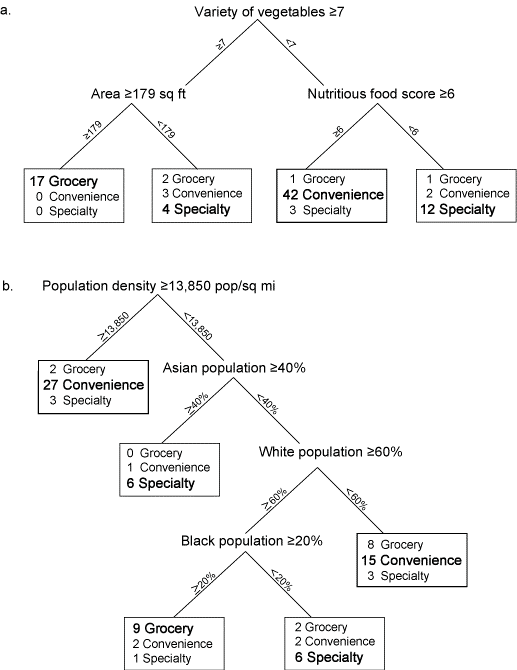
(Quelle:https://www.cdc.gov/pcd/issues/2012/12_0023.htm)
Imagine you are an orange juice producer, and you want to optimize the procurement process to avoid food waste. To create a regression tree, you need to feed in some features, which are for example weekday, promotions or holidays. To test which feature has an impact on the sales, every feature combination is tested. With this testing, you receive distributions and values, which allow you to rank the impact of the features.
Now let us talk about a real application of Prognosix. The demand of fruits and vegetables has to be predicted. This can be done with a simple tool in a form of a web application. It is based on tables and graphs, just like in excel. With the use of such a tool the EBIT will potentially increase by 10 Mio. Furthermore, food waste and stock-outs can be reduced. All you need is sales data, weather forecasts, are holidays coming soon or are any promotional activities planned. The top-level management was very enthusiastic about this tool, but the production management (PM) did not fancy the tool. They feared to lose their jobs, because they though they will not be needed anymore. As the employees of the PM are still more important for the management, the tool has not yet been implemented.
To sum up the lecture of Prognosix, prediction and forecasting have power and might have impacts. But it is not always easy to realize this power. There are technical challenges, such as the lack of data and non-technical challenges like the fear of employees to lose their jobs. But there also might be a potential for the humans. Data is often messy and it needs insights from experts to tidy it up. Therefore, the jobs will not be lost but rather look different in the future. When we are able to transform data into useful information, already simple algorithms can yield very good predictive accuracy.
To come back to the cold weather: with the knowledge of experts, the regression tree for predicting the amount of cherries which can be harvested in summer, needed the factor that the yield will suffer when the temperatures sinks below zero degrees during the cherry blossom. To conclude, high potential innovation is not successful by itself, it needs a lot of human execution power, intelligence, expertise, knowledge and much more.

(Quelle:https://www.crazycall.com/wp-content/uploads/2017/07/A_quick_guide_to_your_own_sales_forecast.jpg)
 FoodArchitecture
