
By Michel Benoît.
The third day of the module started with Dr. Marcel Blattner, a physicist working for a media company as a data scientist.
I knew that the morning would be devoted to quantum computing and artificial intelligence. Two areas that for me are part of IT. But why is a physicist coming to talk to us about computers?
I must admit that I don’t know much about computers but when Marcel started explaining what quantum computers are, I quickly understood why he found an attraction for this technology (which is actually pure physics). From what I understand, quantum computers work with protons and electrons using quantum physics studied at CERN in Geneva (for example). The researchers themselves do not understand all the details of how the mechanism works. Dr. Marcel Blattner has tried to give us a general picture of the technology that I will try to summarize in this blog post.
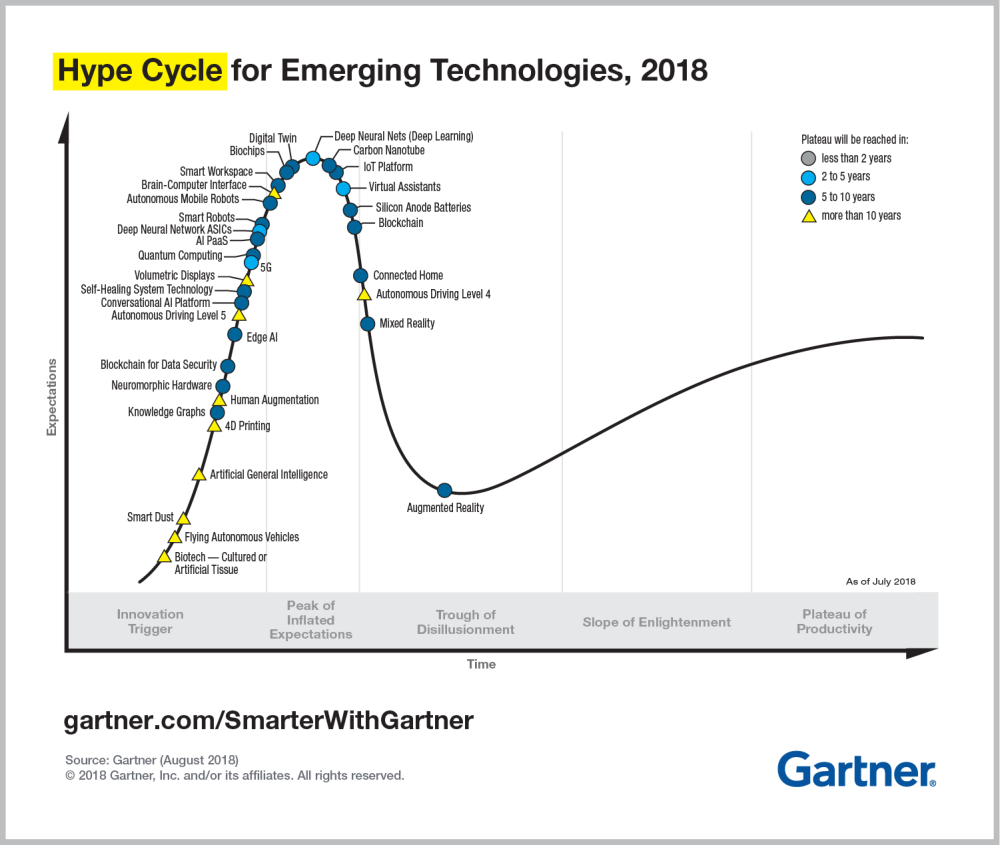
Quantum computers are based on a “new” technology where we do not yet know much about it. We are just beginning to understand how it works and see the possibilities, but we have no idea where this technology will lead us. The technology is on Gartner’s cover at the beginning of the peak of expectations. It means that the technology is just at the beginning to the development, we don’t know all what we do with this. However, according to Dr. Marcel Blattner, we would not be as advanced, and it will take much longer to reach the peak of expectations or even to standardize the technology. However, there is a euphoria about this technology because these computers might make things possible that are not yet possible with today’s computers.
But let’s start with a few basics of quantum physics: Atoms are created in the stars. We can even classify which atoms are created at which time or in which place. Einstein said it himself: Energy cannot be created or destroyed, it can only be changed from one form to another.”
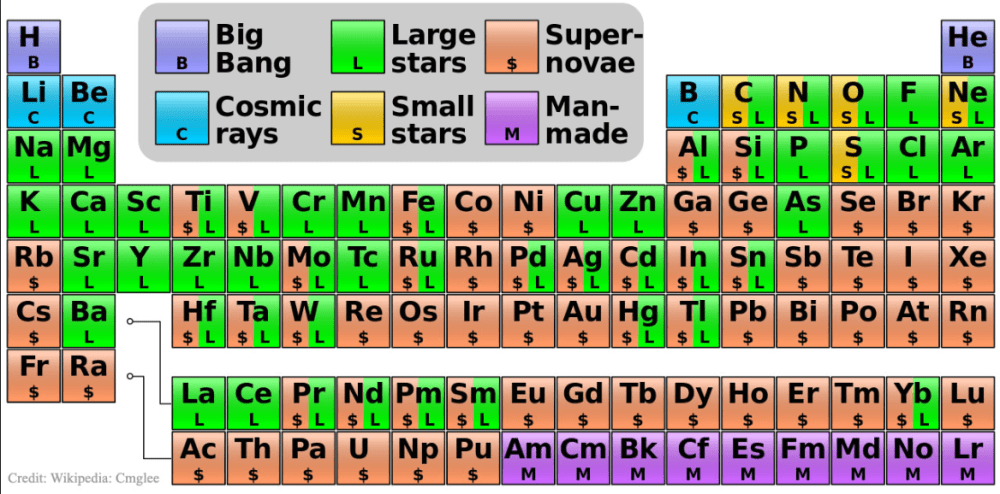
(Source:https://www.laiyla.org/index.php/grupos/2-kiai-yoga/fotos/669-nucleosynthesis-periodic-table-png)
Following the theories of quantum physics, atoms do not have the traditional form that we learned at school, with neutrons and protons in the center and electrons circling around them, but electrons would move to otherwise defined areas.
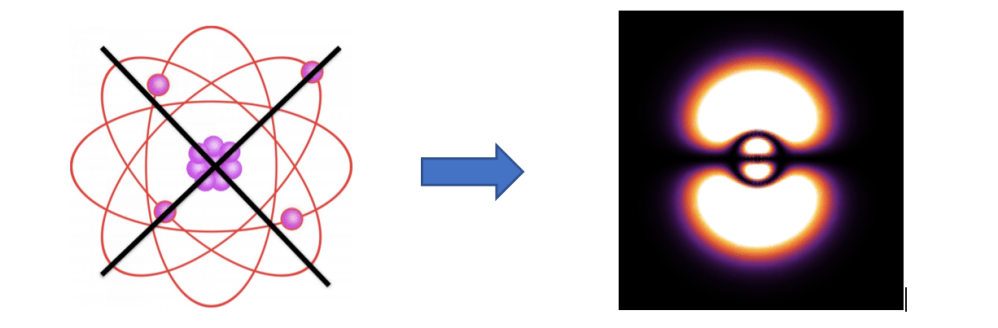
Quantum physics does not seek to define the position of electrons but works with the probabilities of their positions.
If we take a flow of atoms in different very thin tubes, so thin that the particles are almost isolated, the electrons can be in two tubes at a time… at that moment I lost Dr. Marcel Blattner… but this effect will limit the power of computers today… or some things like that….
Another mysterious aspect that Dr. Marcel Blattner tried to explain to us is that if we propel balls through a plate with two slots on a wall, two lines will be created. If, on the other hand, waves are propelled on the same two slots, two different waves will be created on the other side of the plate, colliding and creating several lines on the wall. Now, if we propel electrons, they will react like waves, so they will interact with each other after the slots and create more than two lines against the wall. But if we observe the cracks as we propel the electrons, they act like balls and create two lines against the wall. So, atoms react differently when they are observed, and we cannot explain why.
The example of doubts about the very structure of electrons and the example of their interactions show how limited our knowledge is today….
Quantum computers work with protons and electrons and the two explanations provided by Dr. Marcel Blattner were chosen to show us the current state of our knowledge and make us aware that this technology is still in an early development stage.
But that doesn’t explain the difference between normal computers and quantum computers. From what I understood, normal computers work with values of 0 and 1, and quantum computers with all values between 0 and 1 at the same time. This makes computer much faster and more efficient.
A normal computer today requires 3*108 years to factorize 2048 into prime numbers, a quantum computer only needs 36 minutes! This speed will make it possible to decode all the (en)coded communications of today’s banks and insurance companies, for example.
However, creating algorithms with quantum computers remains much more complicated than with conventional computers. And it will certainly take many more years of research.
The power of this new technology, however, opens a new door and allows some people to imagine scenarios that are a little fantastic.
As already mentioned, my knowledge of physics and computer science is really very small, but I hope I didn’t say too much nonsense and maybe provided a brief and simple summary.
I am personally surprised to see once again that, as in other fields such as genetic engineering or food science, the less we know about the subject, the more we are afraid of it and image bad scenario. People who don’t know this technology will imagine Everything potentially possible that might follow from the technology and be afraid of it. When you listen to specialists like Dr. Marcel Blattner, they are much more down to earth, because they know the limits, what you can do and what you can’t do. Unlike a free newspaper article like an article on GMOs within a free newspaper for example.
 FoodArchitecture
