
By Karolin Wiezel.
Today, on the second-to-last day of the very interesting and intensive Digital Food Business week, Kauf Peter from Prognosix was our guest speaker. They are a leading Swiss company for scientific, mathematically based forecasting systems, which want to bring more security into complex decision-making processes.
Prognosix offers prediction models in the following fields:
- Food supply chain
- Healthcare
- Safety and prevention àg. forecast for accidents on the streets
Can we solve problems like food waste & stock-out by means of the interaction of algorithms and humans?
- From Peter Kauf we got a general impression of the power of prediction and about one particular prediction algorithm (the regression tree).
- He also gave us some information about the challenges of introducing innovation to a company that is driven by daily business with a complex landscape of stakeholders.
- And finally, he also wanted to make us understand why big data and artificial intelligence (ai) per se are limited for a lot of very interesting applications.
Food waste and stock-out lead to a massive loss of sales and therefore massive profit loss.
As Peter Kauf showed us, one way to fight against that problems may be the interaction of modern algorithms (they have not to be very complex) and humans (experience and gut feeling).
With the interaction of modern algorithms and humans we can deal better with predictions, but a prediction still stays a prediction and we`ll never be 100% sure what is really going to happen in the future.
I`d like to share with you, what I learned today and come up with the following question: What are the challenges a procurement manager has to deal with?
There are such a lot of factors that might have an impact on predictions for a retailer.
For example, factors like weather, holidays, day of the week, promotions, parties, season, bank holiday etc. and of course randomness play an important role.
A random occurrence is not foreseeable. For example, a class of 30 children is on a school trip. By passing a kiosk they decide to go in for buying a chocolate croissant. In general, only 15 chocolate croissants are used per day. In this case it was not predictable that 30 more croissants would have been needed.
But also, the not existing transparency in the supply chain is a factor which has an impact on predictions. Many companies do not want to make their data public.
Also, unknown data from competitors are a challenge to deal with. It would be quite useful to know when competitors are planning to launch a promotion on the same product as your company is planning.
In general, to make use of these data driven algorithms we need a lot a lot a lot…. of data to feed the system. But if we do not have that data, we cannot feed the computer. And even if we would have the data it`s a problem to predict what customers will buy.
Let’s have a look at two examples.
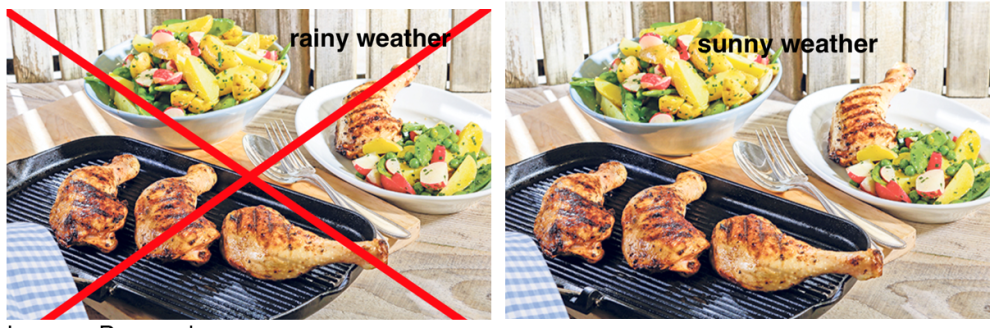
Weather: As we have seen already before, weather plays an important role. Last year we had a very hot and sunny summer. But how the weather will look like this/next summer. If I take the data from last year and we`ll have a rainy summer I can`t sell as many poultry breasts as if it would be sunny and warm.
The next pictures shows the impact of the weather for barbeque for chicken flanks.
Images: Prognosix
Change in the course of time:
People and habits change.
Data from the last 5, 10 or 15 years are maybe not longer valid due to e.g. trends or maybe animal diseases. Therefore, older data seems not adequate for our predictions.
The picture below shows the complexity of a model and which features have an impact on the system.

Images: Prognosix
Where algorithms are used, improvements in prediction cannot always be recognized. We there have to be critical and evaluate the key data. Peter Kauf showed us, that if you manage to transform your data into useful information, already simple algorithms can yield very good predictive accuracy.
But it depends heavily on the data you have given to the system. Which features are relevant? To feed the computers it takes a lot of time, experience from experts and a huge amount of data. That`s very time-consuming to build up such a model.
Many companies also do not want the service from Prognosix. Especially product managers see their job in jeopardy. For employees it means maybe a lot of work but also some challenges. It mainly depends form the management board of the company. They have to decide if they are willing to work with a company like Prognosix and profit from their knowledge.
To come back to the question “Can we solve problems like food waste & out of stocks thanks to the interaction of algorithms and humans?” As I learned from the perspective of Prognosix:
We cannot solve these problems, but we have seen a helpful method and approaches that can deal better with perdition. There my advice is: Be open minded for new stuff but be critical.
More details about Prognosix you will find on http://www.prognosix.ch.
 FoodArchitecture