Where the binary code meets the code of life
Doubling the variables
As we all know, the binary code has two variables – 0 and 1. With these variables functions the whole digital universe. Now, what would happen if these two numbers are suddenly doubled? A more complex system with now four variables arises. The code of life is exactly such a system. There we have the variables T, A, C and G. These stand for thymine, adenine, guanine and cytosine. They are the bases, which together with a backbone (sugar and phosphate) form the basis for all DNA. This complex system and its mutations are responsible for the evolution in this world. Because of these mutations, tomatoes from Italy have a slightly different genetic code than tomatoes from Spain. What happens and could happen if these codes are used together is what you will discover next.
Where two different codes meet
Now, where is a point where these two codes (binary and DNA-code) meet? In genome sequencing, the entire base sequence of a whole genome of an organism is decoded. For this decoding, there are traditional systems such as Illumina Sequencing or PacBio Sequencing. These are very accurate but costly and space-consuming approaches. However, there are also new systems such as Nanopore. This is a system that is smaller than a smartphone. Nanopore uses a transmembrane protein which, with the help of an enzyme, allows DNA to pass through itself and different electrical signals can be used to assign the exact base sequence. Through such a system, genome sequencing can be made possible by almost everybody at a very low price.
Benefit or technical gimmick?
This technology allows us to decode the gene sequences of organisms – but what is the use of it? Of course, we can assign certain areas of the genome to certain processes and detect anomalies. But if another system of binary code is added, like the database, not only can genomes be identified, but they can be compared and traced.
This is exactly the approach taken by the Genome Trackr of the US: Food and Drug Agency (FDA). This is a platform which is mainly used for pathogenic bacteria. All genomes of pathogenic bacteria in food are analyzed (about 1000 per month) and are loaded into the database. There the new samples are compared with all existing data and commonalities can be found. With this database, outbreaks of food caused diseases can now be assigned to the factories of origin. Thus, responsible food can be taken off the market faster and the source destroyed.
Another application that is currently in the news is Covid-19. The genome of this virus can also be sequenced and compared in a database. This way mutations can be detected, e.g. in England, and the different behavior of the virus in different countries can be compared.
The two sides of the coin
Is the future of genome sequencing bright or dark? The answer to this is not clear, yet.
As with everything, it depends on the intended application of such a system. A positive future for this technology in the food industry could be found in combination with the blockchain technology. As food leaves a genetic fingerprint, with the help of the genome sequencing, the full traceability of food could be determined. Thus, consumer deception could be completely prevented.
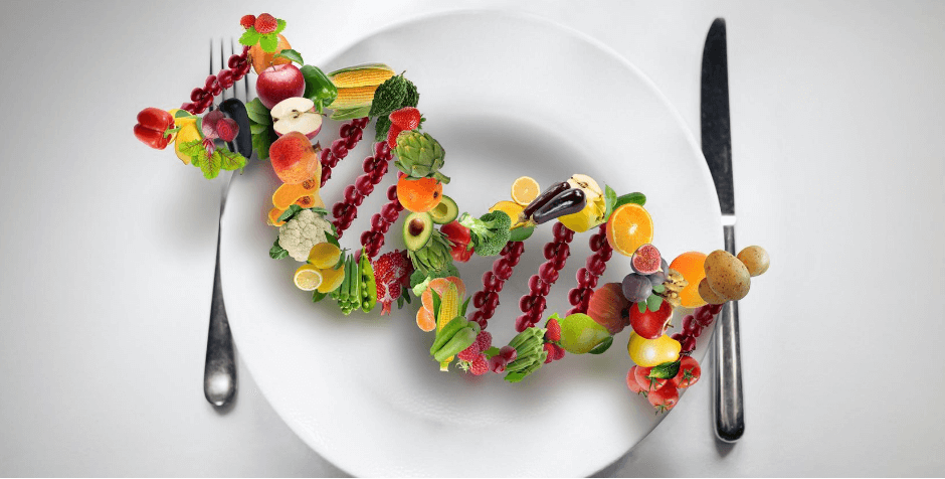
However, there is also the other side of the coin. If the genome of whole foods can be decoded and used, this can also be done with animals and as well as with humans. But do we want that? Do we really want to know everything about ourselves? Mutations or predispositions? Who do we (want to) share this information with? Only with our doctor? Or with the health insurance, which can exactly see by your genome that your predisposition for pancreatic cancer is 5 times higher than the average and therefore you have to pay higher health insurance? Or the state, which can see exactly who carries important genetic material to ensure the continuity of mankind and who does not? The ultimate question is where are the moral limits? Answers to these questions need to be found by institutions, gouvernements and in the end the whole society.
Author: Oliver Bonadimann
Image Source Title: https://elements.envato.com/de/dna-from-a-binary-code-on-a-blue-background-with-s-RCJMD2V
 FoodArchitecture