Digital Transformation – Disrupt or be Disrupted!
With the title “Digital is everything. Understand your customer. Win or learn”, Manuel Nappo opened the digital food business week 2021.
What will the future look like?
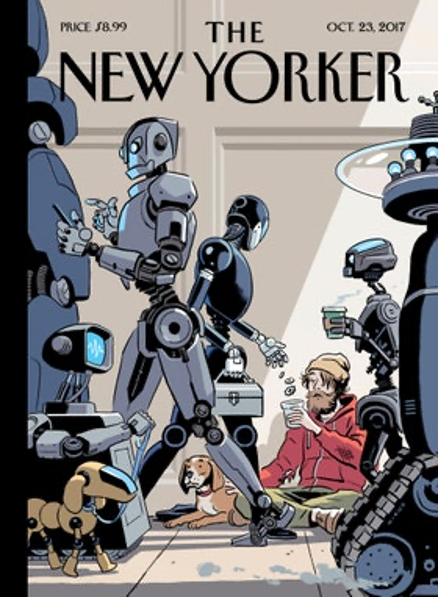
This question and the following cover of “The New Yorker” magazine unleashed the first discussion. Will the robots have taken over and the humans will just be some side characters? Will we have advanced that far, that robots will do all our tasks and chores while only poor people who cannot afford them will be left behind? Or will humans behave like robots because they concentrate on their work and only people without a job stay “human” and live and enjoy life like we are used to right now? These are all possibilities, but ultimately, no one knows what life in the future will be like. The only thing we do know yet is, that it won’t be the way it is right now.
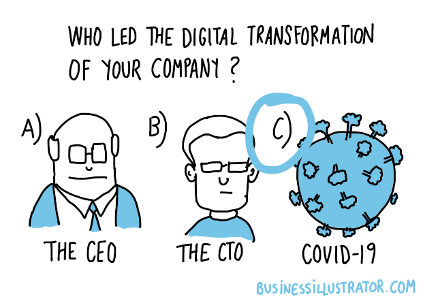
Change is the only constant
The world is transforming constantly and so does the technology. One thing that has changed drastically in the past years are the advancements in technology and digitalisation. The human brain is used to think in a liner way, while the digitalisation is developing exponentially. This will lead to people being left behind if they don’t want to interact with it. Not being up to date to the newest technologies might not have been a big problem in the early 20th century, but it is very much right now. In contrast to the early developments of computers and smartphones, where such devices were viewed as a gimmick or even as a toy, they are now implemented into our lives and we depend on it. So, while somebody may have decided in the 1920s not to buy the newest vacuum cleaner, it wouldn’t have been much of a problem, as they didn’t change drastically in the following years. However, if somebody decided not to interact with computers in the early 2000s, he wouldn’t understand most processes or opportunities in the following years. And this will not get better in the future as the progresses in digitalisation are building on the existing technology and are moving immensely fast.
Connection is key
The rise of various social media platforms is remarkable. A closer look at what people like so much with these platforms shows, that they deliver a very basic service which everybody can use and understand. Humans want to be connected, and with social media they can do exactly that by sharing pictures, thoughts, emotions, etc. and all that for free. Sounds like a bargain. However, whenever you do not pay for a service, you are the product! And social media needs users as their product to gather data. Therefore, they are designed to be addictive by automatically playing the next video or by showing you recommended posts as soon as your personal feed is viewed. With this collected data about every user, personalised recommendations and advertisement can be placed. Therefore, the internet browser looks different for every user depending on their interests and former searches. This leads to bubbles of constant similar information regardless of its correctness. If people are not eager to step out of their bubble to find alternative information, it can lead to misinformation.
The evil digitalisation
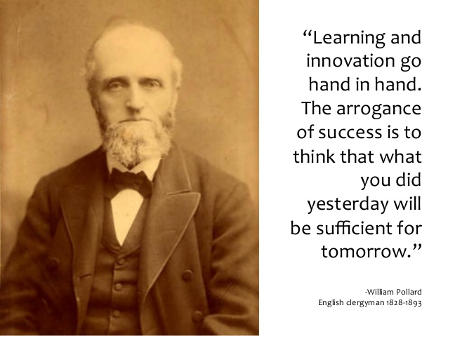
Digitalisation will destroy our jobs! It will destroy entire industries! Yes, this may be the case in the future or has already happened. Terrible, right? No! Not really, because companies or people who complain like that are often the same that don’t want to follow the progressing digitalisation. They missed it. “Everything used to be better” or “The good old times” are other statements which often support such a worldview. But this is usually the mindset which initiates failure. The quote of William Pollard sums it up, if we do not look forward and try to innovate, we will be left behind and disrupted eventually.
Digitalisation is controlled by the people and therefore it can’t be blamed. The only thing to blame is us! And as blaming something or somebody rarely helps anybody, companies and industries need to adapt. Companies depend on scarcity to be successful. However, the rise of digitalisation created abundance from scarcity in some cases. One example is taking pictures. While you had to pay for camera, films and development in the past, the smartphone made all this obsolete and everybody can take as many pictures as he wants for free.
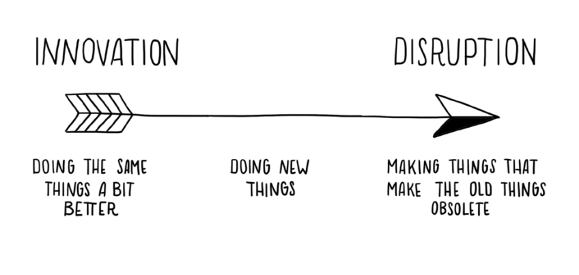
Prepare to disrupt
To keep up with digitalisation, innovative thinking is not enough. Disruptive thinking is needed! And in the centre of that is always the costumer. What are the current needs of our costumer and how can we meet them? Without constantly asking this question, you are about to be disrupted! Because other companies will do exactly that, and eventually make your product obsolete. This is currently happening to the Taxi industry. UBER improved virtually every aspect of the Taxi experience and is so disrupting them. Besides this disruptive thinking, timing is the other important variable. So, it is not only the question of how and what we are going to do but also when! The market may not be ready for your product yet. Microsoft launched a functioning Tablet computer in 2000 and failed. However, when Apple launched the iPad 10 years later it skyrocketed. So, the technology and the costumers were not ready for such a product in 2000 but they were in 2010. Knowing what is going on in the world is crucial for developing successful products. Predicting what the future will be like would be even better, but as we have seen at the start, this is extremely difficult and never certain! So, our only option is to keep moving forward, analyse our environment, embrace the digital change and adapt to it. Or in the words of Elon Musk:

In my opinion, it is not a choice if you want to be part of it or not. It is more a choice of survival or eventual death. I think it is crucial to precisely analyse the costumer and drive digital transformation forward wherever possible. Because if you try to do that, you either win or learn, and by not trying, you already lost.
Author: Jules Rentsch
Image Source Title: https://www.salesmag.ch/was-ist-digital-transformation/
 FoodArchitecture