
AI & quantum computers
News about bigtech advancements reaches us daily. Is it all true and possible? Always do your research, especially if it sounds disruptive. Be skeptic and check the sources. AI achievements that attract strong media coverage have to be taken with a grain of salt. This happens because the mass media is inclined to publish corporate biased articles with the outlook of making profits rather than reporting of advancements from the academic world. For example, the news of computers developing an own language and using it for communication was in fact misinterpreted gibberish from over enthusiastic reporters.

Source: https://reutersinstitute.politics.ox.ac.uk/sites/default/files/2018-12/Brennen_UK_Media_Coverage_of_AI_FINAL.pdf
Concerns are often raised with how the job landscape will develop in the next years. It is certain that many jobs from today can be carried out by smart machines. However this does not mean all workers will lose their source of income through an overnight adaption of new technology by society. For one technology is undergoing constant development (as it has since the existence of man) and its integration into society is usually a smooth process. While certain jobs become obsolete new opportunities and possibilities are created.
How AI works
To understand the concepts of modern AI technology lets first have a look at how programs are traditionally coded. Traditional coding is called symbolic or feature engineering. A set of rules are defined by the coder encompassing all relevant features and algorithms based on these rules are used to process data. In the symbolic approach the rules and algorithms are coded before the beginning of the program and they never change. Examples for this are autopilot or creating the schedule for railways.
On the other hand there is connectionism. In the connectionism approach there are no predefined rules, just the goal is specified. The machine looks for specific patterns in the data and based on these patterns it creates an algorithm. The rules are based on abstractions the machine made from the input data. With each new input of data the algorithms are adjusted to come up with the answer that has the highest probability of being correct. The cost of this system is transparency, the rules extracted by the system are based on the logic of machine and in many cases cannot be understood by humans due to the multitude of factors contributing to the solution.
Smart system such as neural networks are constructed using the connectionism approach. These networks can approximate whatever function is behind a data set with an arbitrary amount of dimensions. Different types of “learning methods” to train a neural networks exist. Typically for common business applications the supervised learning method is used.
With this method a question (target value, label) is answered based on the input of a complex data set. Common questions are: “Is this individual credit worthy?” or “What is the probability a customer will watch a certain movie on Netflix?”. The neural network learns the correlation between the data and the responses. Another approach is reinforcement learning. This is useful for games or self-driving cars. The machine finds a solution to navigate a certain environment to generate the highest possible reward. For example a self-driving car must reach the destination in the fastest way possible while respecting all input rules (traffic laws, weather conditions, human behavior etc.) In Unsupervised learning there are no initial labels or target values. The machine finds the rules based on the given data points and forms a specific structure. The goal is to find clusters, groups or patterns.
Is the brain computable?
Given these factors, even by the strong adherence to Moore’s law, AI that is capable of consciousness is highly unlikely to happen anytime in the near future. AI is still fully dependent on its code and input data, it cannot create new goals, only reach the predestined goal in the most efficient way possible. In addition researchers do not agree to the fact if it is even possible to compute consciousness. Perhaps consciousness is of a different matter and not able to be expressed through mathematical functions (Dualism).
Quantum computing The original motivation behind quantum computers was to use them to simulate quantum particles. Since quantum computers and the quantum system which were to be analyzed are based on the same laws it is the best way to make accurate calculations. This idea of quantum computing was first formulated by Richard Feynman in the 1980s. Since then big tech companies and institutes have become heavily involved in the development of quantum computers. Companies such as Alphabet Inc., NASA or renown universities are contributing to ongoing projects.
Quantum computers use the spin state of particles (atoms, electrons, molecules) to calculate problems. In contrast to traditional computers which use a binary code (either 0 or 1), the 0 and 1 state exists simultaneously in quantum computers. This is due to the nature of spin states of for example atoms which have a positive or negative spin but can also exhibit a super positioned spin (positive and negative overlapping spins). This systems allows the computer to look into different records at the same time, drastically lowering computing time. This is especially useful for the calculation of factorized problems such as encrypted codes. Typically codes are encrypted by decomposing very large numbers into a specific set of prime numbers.
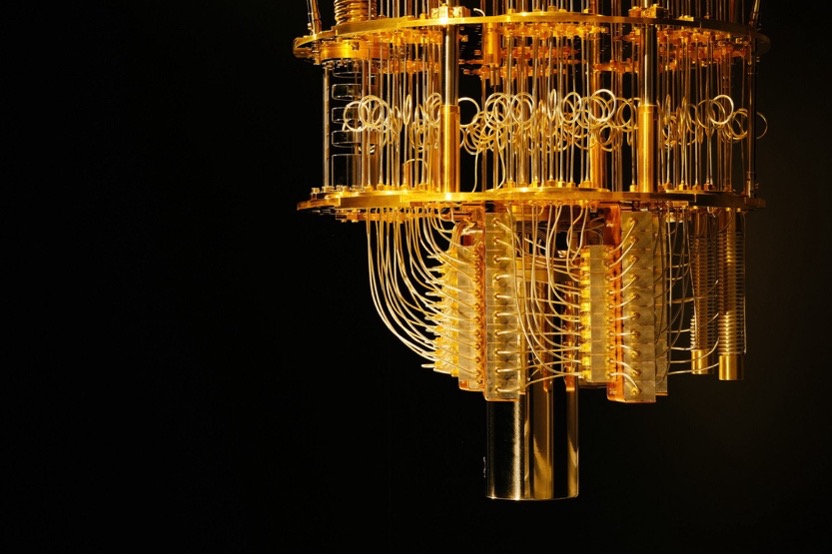
Source: https://cdn-images-1.medium.com/max/2000/0*MJ1ee3fZ2aEqvBnB.jpg
With traditional computers code lengths of 2048 qbits take 300’000’000 years to crack. With a quantum computer the time is reduced to 36 min. (438 x 10^10 times faster). At the moment such computer system are highly costly and difficult to maintain, since quantum computers work optimally around the point of absolute zero (-273,15 °C). However there development poses a strong risk to traditional encryptions. New encryption methods, which are quantum safe have to be developed. It’s an arms race, stagnation is death.
Author: Victor Koetter
Image Source Title: https://cdn-images-1.medium.com/max/2000/0*MJ1ee3fZ2aEqvBnB.jpg
 FoodArchitecture
