
Hyperconnectivity, New Vertical Living and Nature
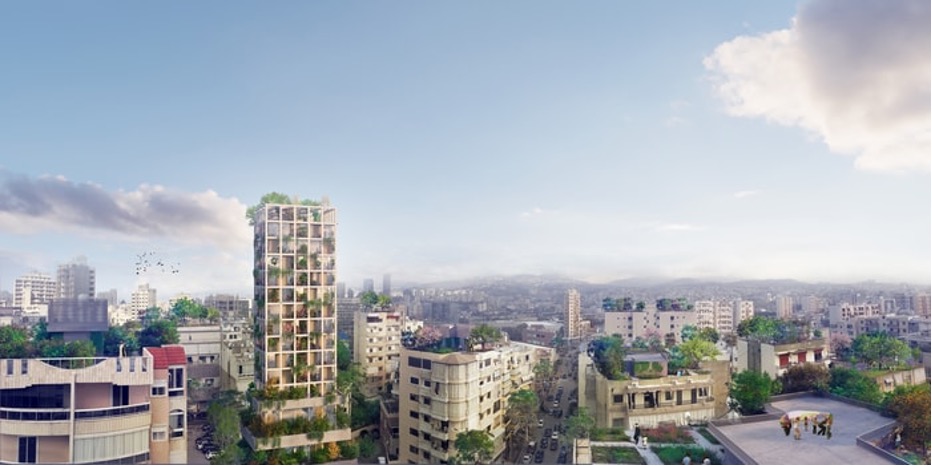
In Urbanism, the process of verticalization refers to the tendency of buildings in urban landscapes to verticalize in response to population growth and reduction of available space for housing and socio-economic purposes (Boon Edam, 2019). A UN report projects an increase of c.a. 2.5 billion people who will be living in cities by 2050; two out of every three people are likely to be living in cities or other urban centres, increasing the need for a more sustainable urban planning (UN, 2018).
This urban expansion could stress the agricultural system, as «processes of suburbanization and patterns of urban sprawl can have profoundly detrimental effects upon local food production and regional food security» (Newman and Nixon, 2014). A vision of a new urban structure designed for and implementing steps towards a regenerative future is a matter of interest. A futuristic solution can be found in food architectonics. A view of enhancement of food architecture aspects, in particular with regards to cultivation, processing and trades (FoodArchitecture, 2022), lies in the concept of ecovillages.
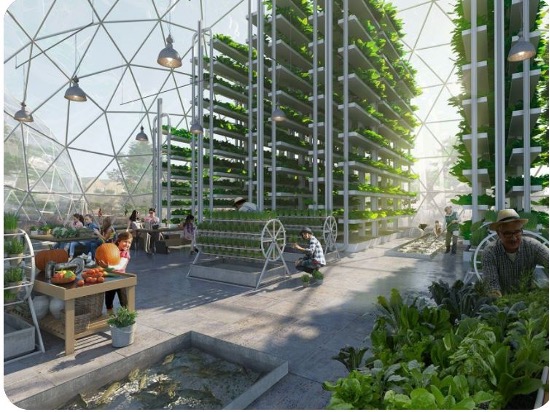
Ecovillages, also referred as eco-communities, are a specific type of intentional community defined by their strive to foster environmental sustainability and (re)build connections with nature, based on shared environmental values. They represent an explicit attempt to overcome the perception that society and the “built” environment separate humans from the natural world (Newman and Nixon, 2014). Eco-communities are a mixed structure of agricultural and residential uses. Cultivation and food generally play a major role and equitable trade becomes central. These systems value exchanges that lean towards fairness and transparency. An example of such a community is Gaviotas, an ecosystem located in South America which relies on renewable energy technologies, hydroponic farming techniques and a regenerating forest.
Verticalization of “City-Scapes”
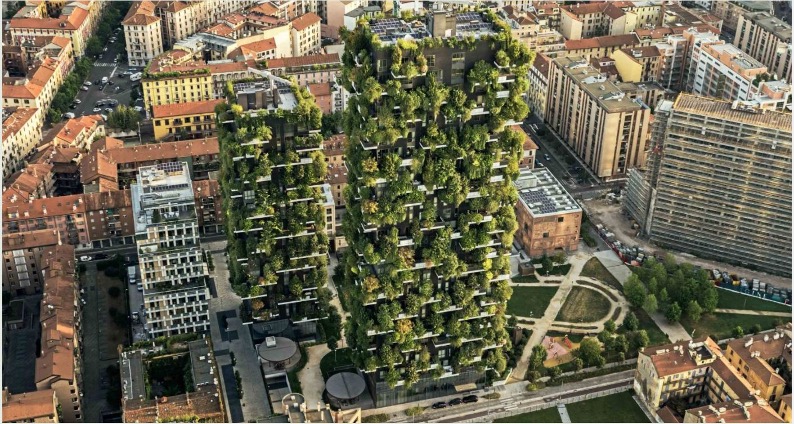
«The City-Scape opens-up spaces within which one can start to move, as a person on one’s own.» (Schildberger, 2020).
Referring to the concept of Digital Architectonics proposed by Schildberger (2020) , the term “City-Scapes” signifies the inversion of Land-Scapes induced by Computational Grounds and Informational Thinking.
The process of verticalization in urbanism is related to the concept of power and consumer culture (Google Arts & Culture, 2021), and so are eco-villages, which tend to envision a world of empowered citizens and communities.
«The Vertical Scape allows us to temporarily stop the linearity of time — the global time of history — which proceeds inexorably in any hardware, such as in nature and the pyramid. The garden, such as the city and buildings, provides temporary shelter and peace. It allows for peace by inclusion — of noise and the multitude — where everything is represented in an indexical manner and enabled to co-exist.» (Schildberger, 2020).
Today, we are facing informational abundance and living in hyperconnected societies where Information and communications technologies (ICTs) are yet to achieve their most revolutionary developments. Human-computer interaction is transforming into human-computer cooperation (Bauer et al., 2015). These could be the forces behind the research of vertical structures for an alternative living, also with the support of the concept that «vertical frameworks are informational» (Schildberger, 2020).
Hungry for Open Source and Redefining Open Spaces

An open space is an undeveloped land that is protected from development by legislation and accessible to the public (Collinsdictionary, 2022). The concept portraits a space without buildings that includes green spaces such as parks and community gardens.
An ever-growing structural density leaves less room for new open spaces in the city, as the urban population’s desire for more qualified open spaces is growing. This leads to the necessity to depart away from the traditional way of conceptualising and developing open spaces. To this regard, Zintl and Treml (2016) formulated the idea of the vertical open space, a symbiosis of built and open space, and therefore the combination of architecture and the objectives of landscape architecture.
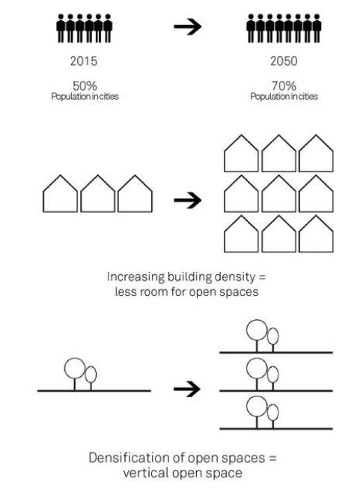
The development of vertical gardening technology could allow the transfer of parks inside buildings, and the sense of accessibility would contribute to make people feel closer to «nature» (Gagulina and Matovnikov, 2018).
Open-source tools and platforms are part of community-based technologies which are increasingly appreciated from software developers. Colin Eberhardt (2018) remarks: -Working on an open-source project with a group of people you’ve never met teaches you a lot about how to interact with people. Learning how to work collaboratively with a group of strangers is a great life skills.
«Mathematics makes things operable and thereby allows us to engage and learn. Thereby we can act in symmetry to that which is yet unknown but can potentially be known.» (Schildberger, 2020).
Main characteristics of open sourcing website are possibility to modify and redistribute. On the other hand, verticalization is one of the fundamental factors for the modification of urban morphology (Roso, et al.,2021). Similarly, they both account for evolution and modernization.
Technological advancement as a leverage
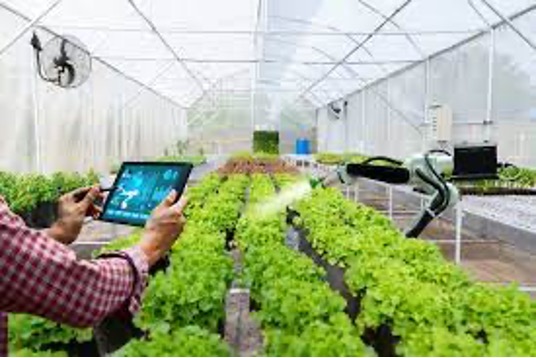
Connectivity supports the creation of a sophisticated internal organization within a system and offers fertile ground for multiple interactions. By 2050, the average farm is expected to generate an average of 4.1 million data points every day (Talaviya et al., 2020). AI- based technological solutions in agriculture such as automated irrigation, automated soil sensing techniques, chatbots and virtual assistants are already contributing to produce a greater output with less input and of a higher quality. Today we may regard to these methods as emerging technologies, but digitalization is likely to play even a greater role in our environment in the future.
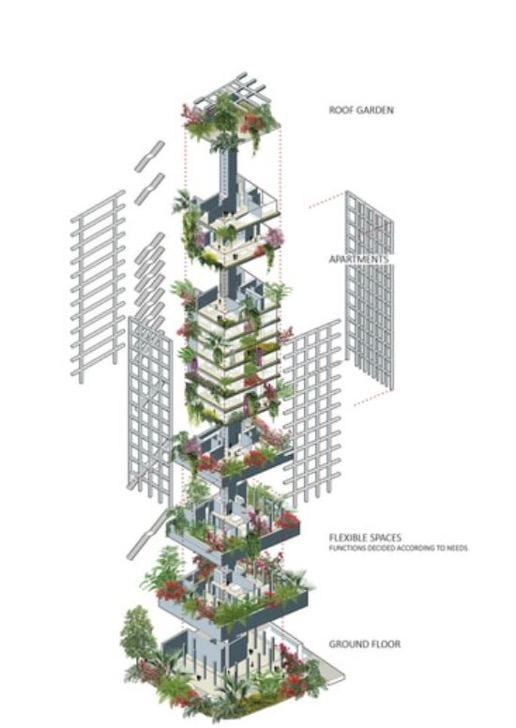
Changing the current image of the relationship between nature, food, technology and communities to a high-rise construction could be an alternative scenario for future urban communities. The actual creation of these models would bring plenty of challenges on different levels. However, one should not rule them out as a potential opportunity to deal with societal complexity in harmony with nature and concurrently with the exploitation of disruptive technologies.
Author: Idongesit Bassey
Image Source Title: Anastasia Elrouss Architects
References:
Bauer, W., Hämmerle, M., Schlund, S. and Vocke, C., 2015. Transforming to a Hyper-connected Society and Economy – Towards an “Industry 4.0”. Procedia Manufacturing, 3, pp.417-424.
BOON EDAM, 2022. What is Vertical Urbanisation. [online] Available at: https://www.boonedam.com/blog/vertical-urbanisation [Accessed 11 January 2022].
Collinsdictionary. 2022. [online] Available at: https://www.collinsdictionary.com/dictionary/english/open-space [Accessed 10 January 2022].
Eberhardt, C., 2018. 7 reasons I love open source. [online] Opensource.com. Available at: https://opensource.com/article/18/11/reasons-love-open-source [Accessed 12 January 2022].
FoodArchitecture. 2022. ABOUT. [online] Available at: https://foodarchitecture.blog/about/ [Accessed 11 January 2022].
Gagulina, O. and Matovnikov, S., 2018. Spatially organized «vertical city» as a synthesis of tall buildings and airships. E3S Web of Conferences, 33, p.01002.
Google Arts & Culture. 2022. Verticalization. [online] Available at: https://artsandculture.google.com/entity/verticalization/m0ryt02k?hl=en [Accessed 11 January 2022].
Newman, L. and Nixon, D., 2014. Farming in an Agriburban Ecovillage Development. SAGE Open, 4(4), p.215824401456238.
Schildberger, D., 2020. ON FOOD. Dr. sc. ETH ZURICH.
Roso, M., Oliveira, T. and Beuter, N., 2021. Por que verticalizar? Um estudo sobre o processo de verticalização nas cidades. Research, Society and Development, 10(17), p.e250101724737.
Talaviya, T., Shah, D., Patel, N., Yagnik, H. and Shah, M., 2020. Implementation of artificial intelligence in agriculture for optimisation of irrigation and application of pesticides and herbicides. Artificial Intelligence in Agriculture, 4, pp.58-73.
United Nations, 2018. Around 2.5 billion more people will be living in cities by 2050, projects new UN report. [online] Department of Economic and Social Affairs. Available at: https://www.un.org/en/desa/around-25-billion-more-people-will-be-living-cities-2050-projects-new-un-report [Accessed 11 January 2022].
Zintl, I. and Treml, S., 2016. Vertical open spaces. [online] Future Architecture. Available at: https://futurearchitectureplatform.org/projects/1ff681bf-e004-4940-aa77-4941a510aaf1/ [Accessed 11 January 2022].
 FoodArchitecture