
The digital era, predictive tools and other things
It is not a secret (for anyone), that technology has become an important part of our daily life. You, my dear reader, are probably reading this part of my thoughts on your cellphone and I bet that is not the only thing you are doing “at the same time”: you probably are answering messages, watching memes and searching for something on the internet…but how comes? Technological progress has closed so many bridges, made life easier, more information available and allowed most of us to become digital natives that rely just way too much on technology. Most of us can’t imagine a life without a device which allows us to do pretty much everything, without having the chance of not only hear the voice of the person we are calling but also see his or her face no matter where in the world they are and I could continue with plenty of further examples. Despite the incredible progress in technology and digitalization that has occurred over the last years, some of us are still impressed and, sincerely grateful, just because now we can close the YouTube App in our cellphone and the video still continues…
But let’s go back to this idea that technology somehow makes life easier and with the aim of make life easier and information more accessible. All the achievements are way more remarkable than doing a FaceTime-call with my mom in Colombia while being in Switzerland. The power of access to information and its availability has allowed huge companies like Kägi to rely most of the production planning on an algorithm. And what about the current COVID-19 situation? The fact that we could come up so fast with not only one but at least 3 vaccines against the virus is a clear example of technology at the service of the human kind accelerating new scientific discoveries.
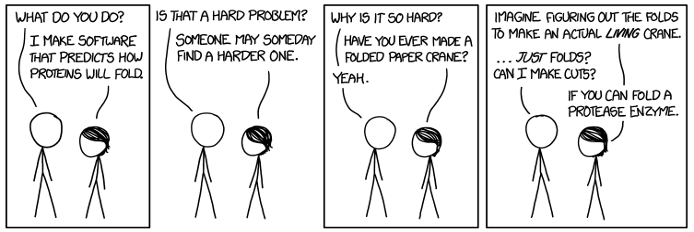
Besides this unfortunate “trending topic” there is another example of how this new digital era has become fundamental, as in this case, for developing predictive tools that bring with them a huge range of possibilities: AlphaFold2 is an AI system developed by DeepMind that predicts a protein’s 3D structure from its amino acid sequence and actually it has been a great deal of help since the underlying machine learning algorithm made it possible to predict the novel structure of two proteins from SARS-CoV-2. This discovery is huge!
If you my dear reader come from the food context, such as I do, you are probably wondering if these tools are somehow also applicable in the food industry? The answer to that is yes! Another unfortunate statement is that the world population is expected to be 9.8 billion people by 2050 and how to feed them is the huge question that probably alternative proteins will help to answer. Considering this and the fact that nowadays more people are turning into a flexitarian, vegetarian or vegan diet, research on the field of plant-based proteins is getting more and more relevant.
When developing a plant-based product the aim is to achieve the same taste (or at least a comparable one) and texture as in animal-based products. Currently, manufactures include in the formulation of the food gelling and emulsifying agents to give some structure to the product and to deliver the proper sensory experience to the consumer. However, most of these agents are not natural components or simply don’t provide nutritional value. Therefore, finding functional alternative proteins becomes a great deal of importance, not only product but also environmental wise. However, one of the most resource demanding steps to find this proteins is the experimental validation that a protein performs a certain target function. In the end, this is the most relevant criteria to proceed with the product development. The more we are able to know about a protein structure – the better we can determine its function.
At this point the predictive tool AlphaFold2 is able to help: by generating very accurate protein structure models for almost any given protein sequence! Its utilization and further development in the context of food would help to determine the protein function and direct the identification of the best protein ingredient for a defined target function based on its structure and change the game of new planted-based products and bring the development onto the next level.
Buckle up, hold on tight, the future is now.
Author: Tatiana Avellaneda
Image Source Title: https://deepmind.com/blog/article/putting-the-power-of-alphafold-into-the-worlds-hands
References:
Higgins, M. K. (2021). Can We AlphaFold Our Way Out of the Next Pandemic? Journal of Molecular Biology, 433(20), 167093.
https://www.shiru.com/post/shiru-is-breaking-ground-in-leveraging-alphafold-r-to-discover-novel-functional-food-proteins
 FoodArchitecture