Are robots taking over?
The interoperation between machines and humans is getting increasingly important in our food systems. From big food industries to small handicrafts manufactories, we find the use of machines to improve communication and organization throughout the entire product lifecycle, as well as across the corporate divisions distant from the product. Due to automatization and machine learning the corporate processes can be continuously optimized. The transition between the tasks of human and machines are becoming fluid and they are working even more closely together. The division of labor is constantly transforming, so that functions are changing flexibly and employees are challenged to adapt to technological developments.
Hence, are robots taking over? Do we have to fear losing our jobs, becoming useless and that we lose control over the machines and even become victims of the robots one day?
The technical development in the field of artificial intelligence (AI) raises many fears and uncertainties about our future, but it also creates hope and new possibilities.
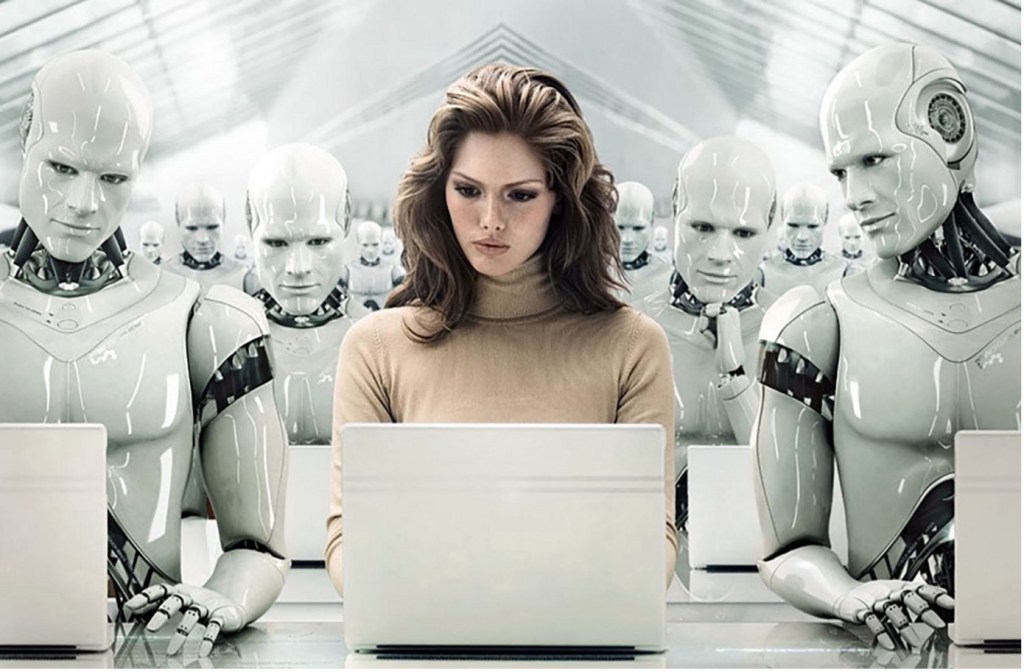
Many tasks need to be solved rationally, even though people often become emotionally involved and make mood-influenced decisions. An aim of using AI technology is to optimize and simplify processes, being faster in decision-making and to make decisions without emotional interference. The decision-making process can be accelerated and even taken over by algorithms. On the one hand, this can be very useful, for example in human resource management, where application documents can be quickly filtered by some key parameters without involving subjective assessments. People are treated equally and are only judged based on predefined parameters. On the other hand, by choosing and defining specific input parameters some candidates, that could have matched perfectly otherwise, would be filtered out by the system due to differing wordings or resume, which was not considered for the analysis. AI can therefore very well be used for clustering and discriminating people, but a limit of this technology is that it can hardly be used to assemble interdisciplinary and diverse teams by looking also at individual factors.
Artificial intelligence can also be used for procurement systems to optimize the prediction of orders and to reduce the bullwhip effect as well as stock sizes. Thus, it is possible to have a decline in food waste and costs without the risk of losing the ability to supply goods to the customer. Whether will the system ever be prepared for special occasions on which it is not programmed to consider nor can it fully abstract the real environment and adapt to new upcoming regulations and movements. Although planning might one day be largely taken over by machines, humans cannot be completely replaced. The responsibility of humans is handed over from operational to organizational, programming and monitoring issues. They need to adapt the system to the real environment and prevent it from the use of biased or too simplified data.
Further applications of AI in food systems show algorithms which can be used to design new menu creations by combining different input parameters in multiple ways and to propose them according to their probability to be liked. With machine learning the overall liking can be increased by optimizing combination settings based on former choices and reviews. Therefore, we might assume that the machines already are creative and as a consequence human food architects could get useless. In fact, if we believe Marcel Blattner’s words (Swiss Data Science Center ETH Zurich), we will even need more human designers in the future, but they will take on different tasks than today. The machines are only able to make countless combinations and provide certain inspiration input, but they are not creative and not able to bring emotions into the creations nor convey messages. Human behavior and their feelings are very complex. Even though there are approaches to use AI to analyze human emotions, it never does justice to the fact that humans and their internal processes cannot be fully psychologically understood, rationalized and encoded.
The question of whether or not robots are taking over must be answered in a differential manner. Machines and AI technologies are tools that help us optimize our processes in order to achieve more efficient systems. Tech experts predict that as we train them and integrate them into our systems, they will take over different tasks and activities. We are moving toward a tightly integrated culture between machines and humans and we need to be concerned about how we deal with this evolution politically. As long as we are able to control the power system, we are in physical control over the machines we use. But it is questionable how dependent our society will become on these new technologies and whether the responsibilities for the underlying processes will be taken over by humans or handed over to the robots.
Author: Katharina Weiss
Image Source Title: https://onbrand.me/magazine/artificial-intelligence-fear-or-hope
References:
https://onbrand.me/magazine/artificial-intelligence-fear-or-hope
Presentation of Marcel Blattner about disruptive technologies (12.01.2022)
Presentation of Dorothea Baur about digital ethics (14.01.2022)
https://www.psychologie.uzh.ch/de/bereiche/dev/lifespan/erleben/berichte/wertbasierte-entscheidungen.html
 FoodArchitecture