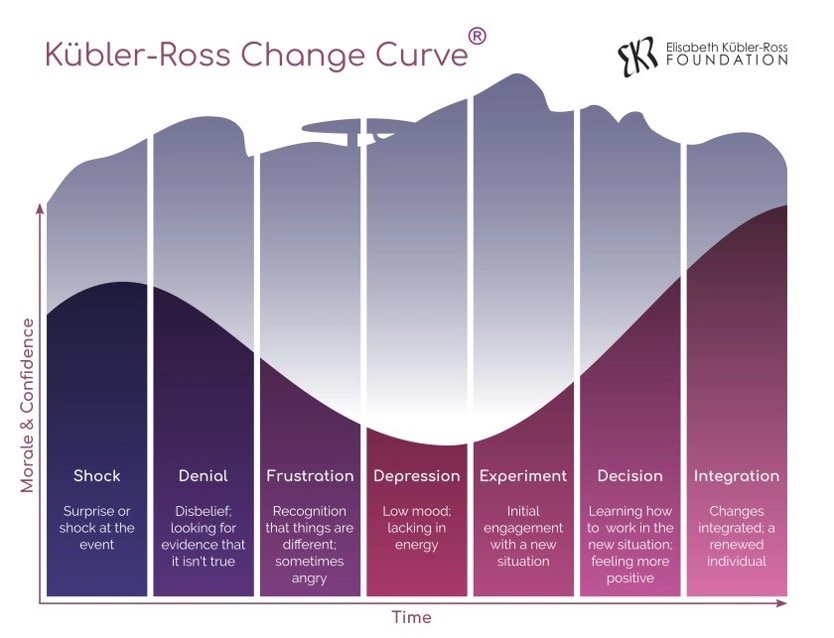
In this era of technological advancement, the food sector is on the brink of a significant digital transformation. It is not only about keeping up with the latest digital trends but also about reimagining how we use technology to produce, distribute, and consume food. Digital innovations that enhance food safety, drive productivity, and enable data-driven automation are leading the way in this transition. To ensure a sustainable long-term implementation of new technologies it is crucial to address the various aspects of resistance that could emerge from food company employees confronted with changes caused by implementing digital processes as discussed by Kübler-Ross in her five stages of change (see Figure 1)[1].
Elevating Food Safety through Tech and Sustainability
The digital transformation provides opportunities for enhanced food safety through technology. Upcoming state-of-the-art tracking systems based on digital technologies, such as blockchain, offer real-time transparency using digital credentials from farm to table, ensuring accountability [2]. These tracking systems could also provide a possible way to comply with the EU Corporate Sustainability Due Diligence Directive, promoting responsible sourcing and overall sustainability [3]. Another tool lies in implementing Six Sigma principles in production facilities to minimise errors, aligning with the commitment to deliver safe, high-quality products tailored to the customer’s needs [4].
Boosting Productivity through Innovation and Savings
Digitisation not only enhances safety but also catalyses productivity. The use of sensors and automation ensures precision and results in substantial time and financial savings for food production companies [4]. Digital modelling and virtual planning through the use of digital twins can simulate the most efficient and cost-effective setup and procedures for implementation in real-life situations [5]. It is important to introduce these transformative technologies sensitively to ensure that current employees understand what to expect and how to deal with them [1].
Using Tech and Data Insights to Improve Customer Satisfaction
Big data analytics provides valuable insights into consumer behaviour and trends [6], optimising inventory management, reducing waste, and creating new marketing opportunities. The potential of data use extends to enhancing the customer journey, with the goal of maximising customer satisfaction [7]. Using specified algorithms trained with the user data of the customer it is easier to provide the customer with products and services that suits its individual needs [7].
Navigating Change for a Reasonable Digital Future
It seems to me that there is no magical blueprint for bringing the digital future to a company. The technology exists and experts are available to help, but I believe it is a very individual task. Digitizing everything and modelling each smallest detail in my opinion is not necessary. I think it is for example important to avoid installing expensive sensors that collect data that nobody analyses. Instead, I would recommend to set-up a well-thought-out plan to identify the key parameters that need to be digitized step by step to maximize the return for the company and its stakeholders. [8]
This blog post was inspired and influenced by a wealth of knowledge from the experts who presented during the Digital Food Business Week 2024 partaking during the master Food and Beverage Innovation (FBI) class at ZHAW in Wädenswil, Switzerland.
| 1 | Philipp Osterwalder | Reaction to change on humans as described by Kübler-Ross |
| 2 | Ingo Rübe | Kilt – digital identity |
| 3 | Prof. Dr. Tilo Hühn | Guardian of the unexpected Food Solution |
| 4 | Dr. Christoph Lustenberger | Six-Sigma BlackbeltSix-Sigma & customer focused specifications |
| 5 | Goran Pavlovic | Siemens – Juuka Plant |
| 6 | Christian Warning | NACS – Advancing Convenience and Fuel retailing |
| 7 | Walter Oberli | Digital Enthusiast – Online Retail |
| 8 | Blog written by Michael Krüger, assisted by the use of ChatGPT 3.5 | |
 FoodArchitecture