Freeing Time for Fieldwork and Community
Solidarity-based Agriculture (Solawi) is built on trust, transparency, and shared responsibility. Producers and consumers jointly negotiate needs and contributions, and prices are meant to cover real agricultural costs rather than follow market logic.
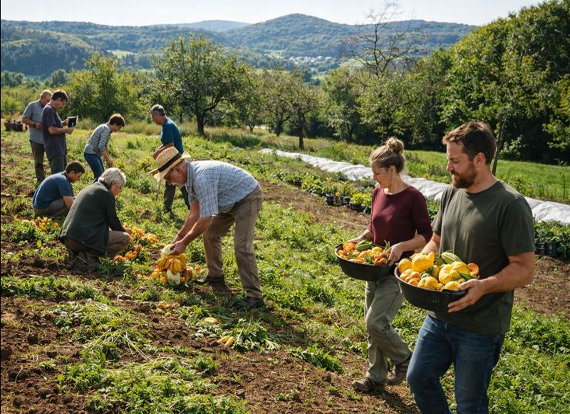
For many, the appeal of Solawi lies in collective workdays in the fields — reconnecting with food production, engaging in physical labour, and being part of a collective process.
What often remains unseen is the organisational work behind this: communication, coordination, and digital administration. These tasks are essential, yet they are usually carried out alongside fieldwork by gardeners or a small group of volunteers.
As Solawis grow, this invisible labour grows with them. This blog post explores whether a quietly operating digital assistant could take over recurring administrative tasks, freeing human attention for soil, care, and community.

The Invisible Work Behind the Harvest
While the fields demand physical presence, much of a Solawi’s daily coordination happens elsewhere. Emails are written in the evenings, questions are answered between workdays, and information is distributed across messaging apps, shared documents, and spreadsheets. Tasks are remembered, forwarded, or informally delegated — often without clear structures.
This administrative work is essential for keeping a community connected and informed. Yet it is rarely visible, rarely shared equally, and often carried by a small number of people. Over time, this can lead to overload, fatigue, and a quiet shift away from the hands-on work that initially motivates many to join a Solawi.

When Tools Create More Work
Most Solawis already rely on digital tools to organise their daily operations. Email clients, messaging platforms, shared calendars and spreadsheets help distribute information, but they also fragment responsibility. Information spreads across systems, and coordination itself becomes a task that requires continuous attention.
Rather than reducing workload, these tools often shift and multiply it. Digital maintenance — keeping messages answered, documents updated, and tasks remembered — becomes an invisible form of labour that grows alongside the community.
A Shift in Perspective
What if the question is not how to optimise administrative work, but how to move it into the background?Instead of asking more people to take on organisational responsibilities, this project explores whether recurring, computer-based tasks could be delegated — without delegating responsibility or decision-making itself. The aim is not efficiency for its own sake, but the recovery of time, focus, and presence.
A Digital Assistant for Solawi Work
The proposed solution is a digital assistant designed to take over most recurring, computer-based tasks within a Solawi. Its purpose is not to optimise productivity, but to quietly absorb administrative work that otherwise competes with time on the field.
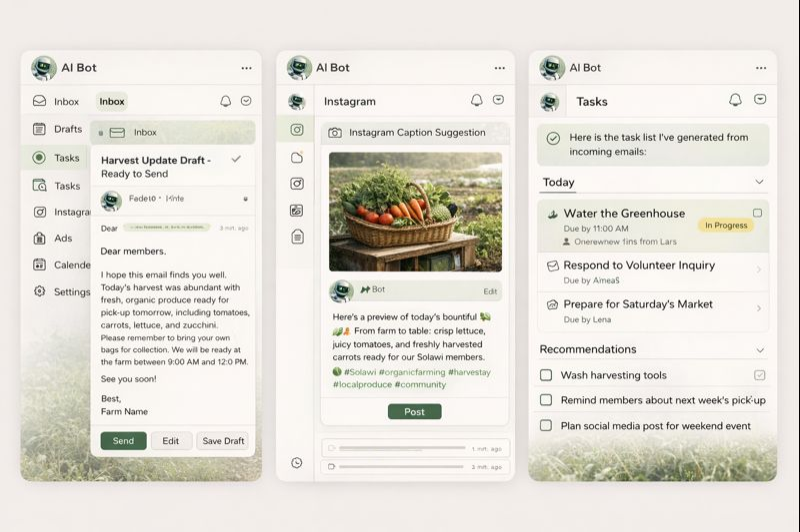
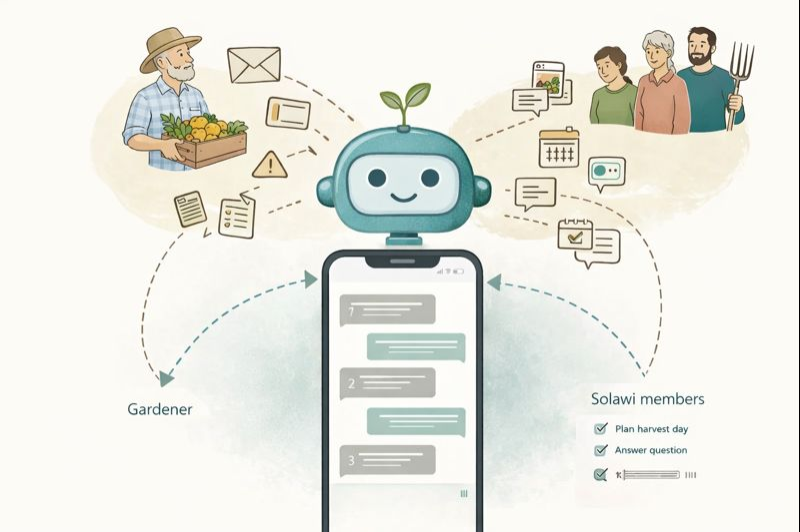
Such an assistant could autonomously draft and organise emails, prepare and schedule social media posts, and translate incoming messages into structured tasks. Acting as a central intermediary, it would gather information from different channels and redistribute it in a simplified, coherent form.
Crucially, the assistant would operate with minimal human involvement. Routine communication and coordination could run largely on its own, while humans intervene only where judgment, prioritisation, or collective decision-making is required. Oversight becomes the exception rather than the default.
In this model, the assistant does not manage people. It manages information flows — reducing fragmentation, lowering cognitive load, and preventing administrative work from silently concentrating on a few individuals.Rather than adding another digital tool, the assistant functions as an infrastructural layer: one that contains digital labour so that attention can return to soil, care, and community.
Automating administrative work in Solidarische Landwirtschaft is not about doing more in less time. It is about doing different things with the time we already have.
When repetitive digital tasks are handled in the background, attention can shift back to what sustains us: working with soil, caring for ecosystems, maintaining relationships, and shaping communities. At the same time, it allows humans to focus on what they do best — interpreting, deciding, imagining, and creating.
In this sense, administrative automation is not a retreat from responsibility, but a redistribution of it. By relieving people from constant coordination and digital maintenance, space opens up for deeper engagement, shared creativity, and collective learning.
In my opinion, technology should function as a support structure rather than a centre of attention — enabling humans to reconnect with food, land, and each other, while remaining free to act as creative, reflective beings.
Carina Herz
AI Credits:
This article was written by Carina Herz with drafting, editing, and image-generation support from ChatGPT (OpenAI, GPT-5.2). All views and positions expressed are the author’s own.
 FoodArchitecture