
Transformational leadership has long been celebrated as the antidote to stagnation.
In a world defined by disruption, leaders are expected to innovate, adapt, and guide organizations through change.
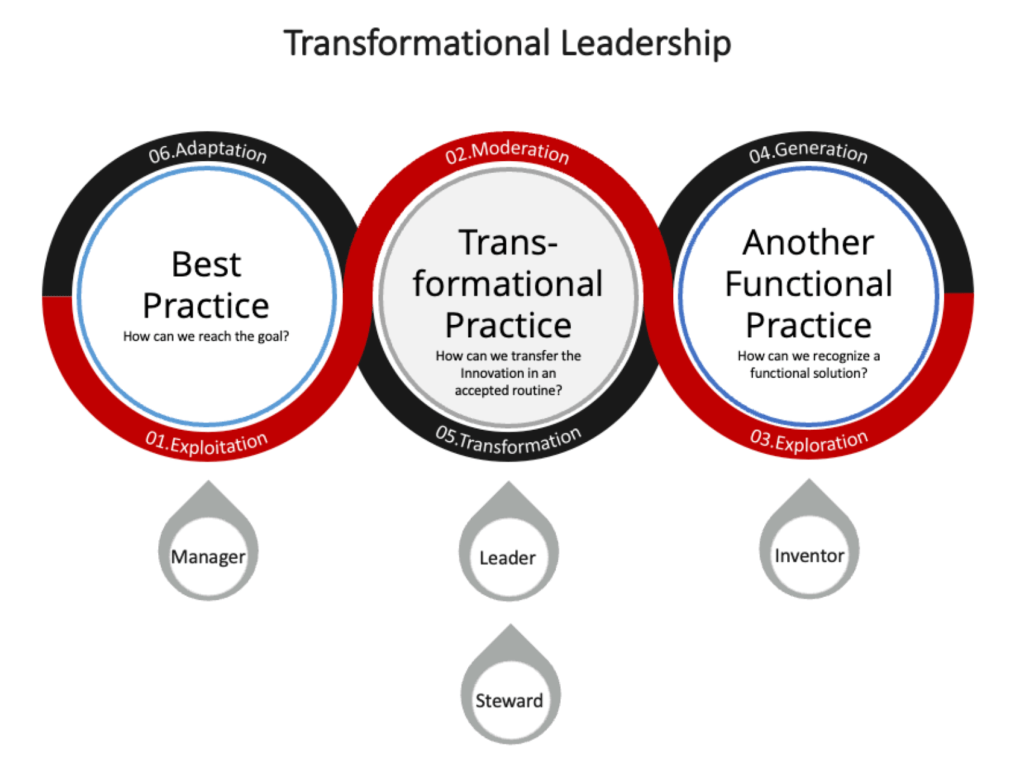
One compelling articulation of this logic comes from Tilo Hühn’s work on transformational leadership, which frames leadership as the bridge between exploitation and exploration—between what already works and what could work next.
In Hühn’s model, transformation succeeds when innovation becomes routine. The leader moderates, integrates, and translates new ideas into accepted organizational practices. It is an elegant and useful framework, especially for technology-driven and performance-oriented organizations. Yet, precisely because of its elegance, it deserves to be questioned.
Then, the question today is no longer only how organizations change—but what those changes ultimately serve.
Transformational leadership assumes that routinization is the end goal. Once a new practice is embedded, the system stabilizes, performance improves, and the organization moves forward. But in complex, living systems—organizations included—stability is not synonymous with health. A routine can be efficient and still be extractive. A system can be innovative and still slowly exhaust the people, relationships, and ecosystems it depends on.
This is where the limits of transformational leadership become visible.
Many organizations today are highly competent at transformation. They restructure, digitize, optimize, and pivot. And yet, they simultaneously experience chronic burnout, decliningengagement, fragile supply chains, and growing ecological and social costs. The system changes—but it does not necessarily regenerate.
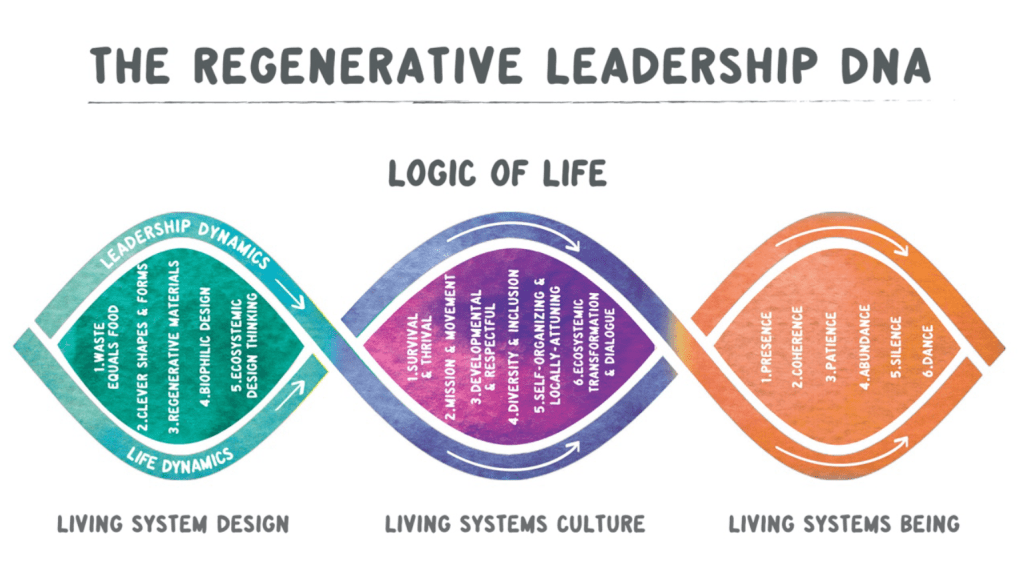
Regenerative leadership, as articulated by Laura Storm and others working in living-systems thinking, introduces a fundamentally different success metric. Instead of asking whether an innovation has been successfully implemented, regenerative leadership asks whether the system is becoming more alive, resilient, and capable of renewing itself over time.
This is not a rejection of transformation. It is an expansion of it.
Where transformational leadership focuses on moving from exploration to exploitation, regenerative leadership focuses on the quality of the system that emerges. It shifts attention from outputs to conditions: the health of relationships, the flow of energy, the organization’s embeddedness in social and ecological systems.
In this lens, leadership is less about moderating between competing logics and more about stewarding the conditions in which life can thrive. Efficiency is no longer the highest virtue; vitality is. Growth is no longer an unquestioned goal; coherence and resilience take its place.
From a systems perspective, this matters deeply. Living systems do not sustain themselves through linear optimization. They sustain themselves through diversity, feedback, reciprocity, and care. Organizations that ignore these principles may appear successful in the short term, but they accumulate invisible debt—human, social, and ecological—that eventually destabilizes the whole.
Seen this way, transformational leadership becomes a necessary but insufficient capability. Leaders must still enable change, integrate innovation, and guide organizations through uncertainty. But they must also ask harder questions, such as: Does this transformation deepen dependency or build resilience? Does it extract value, or does it regenerate the conditions that create value in the first place?
The leadership challenge of our time is not transformation for its own sake. It is transformation in service of life.
In a world shaped by polycrisis—climate breakdown, social fragmentation, and systemic burnout—organizations cannot afford to be merely functional. Leadership must evolve accordingly: from managing change, to stewarding systems that are capable of sustaining themselves, their people, and the world they operate within. If transformation may get us moving, regeneration determines whether we endure. This transformation then signals the evolution of leadership.
Andrea Cristancho.
 FoodArchitecture