Picture this: strawberries are sold out in the morning — yet two crates end up in markdown or the waste bin at another store that same evening. Both things can happen inside the same retail network, in the same week, sometimes even on the same day. The root cause is rarely “bad execution.” Most of the time, it’s a forecasting problem.
In food retail, teams make daily decisions about order quantities, deliveries, promotions, and price reductions — while juggling a messy reality: weather shifts, day-of-week patterns, local events, seasonality, supplier reliability, lead times, and short shelf life. This is exactly where predictive analytics comes in: AI-powered forecasting models that turn data into probable futures, so decisions rely less on gut feel and more on signal.
And this isn’t just tech hype. It’s a practical lever for less food waste, lower inventory and logistics costs, and better on-shelf availability.
1 – Why Food Retail Always Ends Up With “Too Much and Too Little”
Fresh products are unforgiving: short shelf life, volatile demand, and immediate financial consequences when you get it wrong.
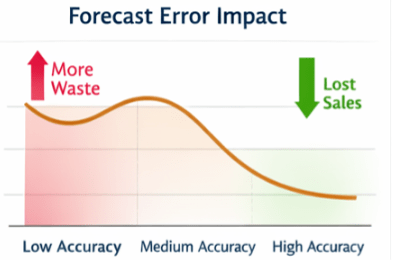
- Order too much → shrink, waste, margin loss
- Order too little → stockouts, disappointed customers, lost sales
- React too late → aging inventory, late markdowns, higher disposal
On a global scale, the dimensions are enormous: In 2022, 1.05 billion tonnes of food (including inedible parts) were wasted worldwide across households, food services, and retail; of this, 12% is attributed to the retail sector. (Source: https://sdg2advocacyhub.org/wp-content/uploads/2024/03/food_waste_index_report_2024.pdf)
Retail isn’t the biggest source of global food waste (households typically are), but retail has something powerful: direct operational control over ordering, replenishment, promotions, pricing, and store-level execution, which makes it a strong place to create measurable improvement.
2 – Predictive Analytics in One Sentence (No Buzzword Fog)
Predictive analytics uses historical data plus context signals to estimate the probability of future outcomes: like demand per store, stockout risk, or spoilage risk.
The key point: it’s not about finding “one perfect truth.” It’s about making better decisions under uncertainty.
Typical data sources in food retail include:
- Sales history (SKU × store × day/hour)
- Promotions and pricing changes
- Weather, holidays, local events
- Lead times, supplier fill rates, on-hand inventory
- Shelf-life and shrink history
3 – Five High-Impact Use Cases That Directly Reduce Waste and Costs
1) Demand Forecasting at SKU and Store Level
Instead of broad averages, models forecast quantities at a granular level and can therefore reducing overstock without creating empty shelves. This becomes the foundation for everything else.
2) Smarter Replenishment (Order Recommendations)
Good systems don’t just predict demand; they recommend decisions:
“How much should I order today to cover demand until the next delivery?”
This is especially valuable for fresh categories where daily adjustments matter.
3) Shelf-Life and Spoilage Risk (Freshness Analytics)
If you can estimate spoilage risk early, you can act earlier: redistribute, trigger donation flows, change display strategy, or markdown before products become unsellable.
4) Data-Driven Markdown and Pricing Decisions
The question is not ‘should we offer discounts’, but rather: when, by how much, and for what quantity so we can ensure less ends up as waste while avoiding the unnecessary burning of margins. There is research that explicitly examines data-driven (dynamic) pricing strategies as a lever for waste reduction in retail. (Source : https://www.sciencedirect.com/science/article/pii/S0959652622007016?utm_source=chatgpt.com)
5) Logistics and Delivery Planning
Better forecasts improve the physical system:
- fewer emergency deliveries
- better route and truck utilization
- lower cold-chain cost per unit
- reduced need for “safety stock” buffers
In other words: forecasting isn’t just an Excel exercise: it shapes the real-world flow of food.
4 – Does It Work in the Real World?
There are real-world retail case studies showing that AI-powered ordering and forecasting systems measurably reduce food waste per store (e.g., in the context of Shelf Engine / Afresh). (Source: https://www.sciencedirect.com/science/article/pii/S2666154325002662)
Furthermore, one provider reports significant effects on shrink and stockouts following implementation (according to manufacturer specifications). (Source: https://www.afresh.com/resources/sustainability-and-profitability-in-grocery-retail?utm_source=chatgpt.com)
Key takeaway: The greatest impact usually does not stem from ‘a cool model’ alone, but rather from the interplay of data, processes, and user acceptance.

5 – The Underrated Part: What You Need for Predictive Analytics to Actually Deliver
Here are the usual friction points — and why they’re solvable:
- Data quality and master data: pack sizes, product substitutions, new items, discontinuations — models need clean logic, not just volume.
- Human-in-the-loop design: teams need transparent recommendations and sensible guardrails, otherwise the system won’t be trusted or used.
- KPI conflicts: availability vs. waste vs. margin — you need a clear target system (e.g., “waste down without breaking service level”).
- Change management: replenishment is culture. If you ignore people and workflows, you end up with “AI nobody uses.”
6 – Takeaways
- Predictive analytics doesn’t “automate everything,” but it can make day-to-day decisions measurably better, especially in fresh categories.
- The upside is concrete: less over/understock, fewer write-offs, lower logistics and inventory costs.
- Success depends as much on people and processes as on algorithms.
Now is your time to enhance your business with predictive analytics!
Marc Bacher
AI credits:
Images created with Gemini Nano Banana Pro
 FoodArchitecture