
From pre-order apps to robotic fryers—how integrating the full tech stack is revolutionizing Roadside, Travel Retail, and QSRs.
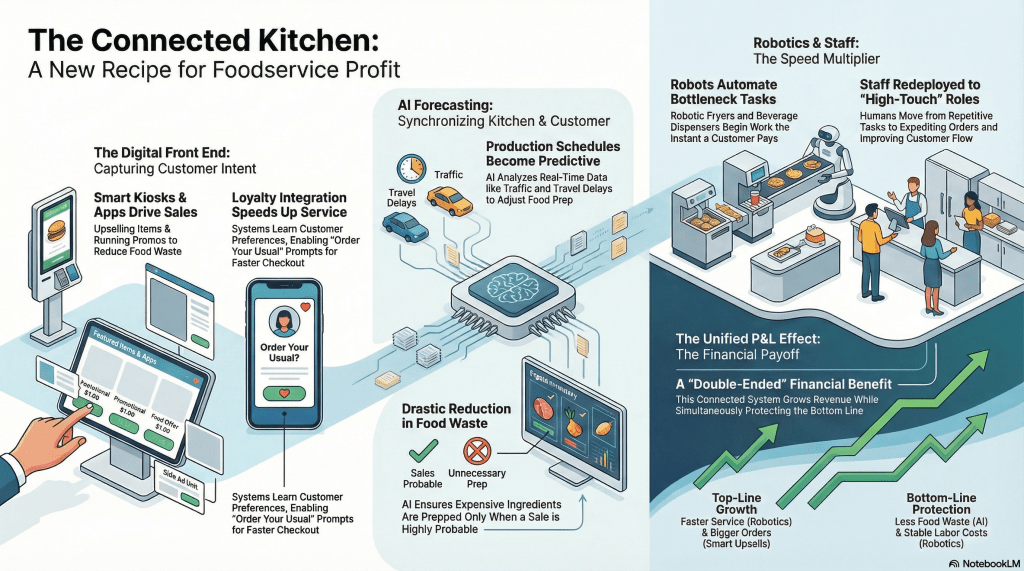
In the high-velocity worlds of Roadside “Foodvenience,” Travel Retail, and Quick Service Restaurants (QSR), the customer mission is distinct: speed is currency. Whether it’s a commuter grabbing a coffee at a highway stop or a family ordering dinner via an app, friction is the enemy.
But delivering blistering speed without sacrificing quality—or burning out a shrinking workforce—is the modern operator’s dilemma. The solution lies in a holistic digital ecosystem. It is no longer just about a robot in the kitchen or an app on a phone; it is about how Order Terminals, Pre-Order Apps, Loyalty Systems, and Retail Media Networks communicate directly with AI-driven forecasting and Robotics.
Here is how this connected ecosystem is reshaping the P&L and the customer journey.
1. The Digital Front End: Data as the New Ingredient
The journey begins before the customer even enters the store. Through Pre-order Apps and in-store Self-Order Kiosks, operators are capturing more than just revenue; they are capturing intent.
- Retail Media Networks (RMNs) & Upselling: Modern kiosks and apps act as dynamic advertising platforms. They don’t just take orders; they influence them. If the back-of-house AI predicts a surplus of perishables (e.g., fresh fruit cups), the RMN can instantly trigger a “Add for $1” promo on the kiosk screen. This drives revenue while simultaneously acting as a proactive food waste prevention tool.
- Loyalty Integration: By linking orders to loyalty profiles, the system learns individual preferences, speeding up the ordering process for the customer (“Order your usual?”) and providing the kitchen with data on upcoming peak demand times based on customer travel patterns.
2. AI Forecasting: synchronizing Supply with “Now”
In Travel Retail and Fast Casual, “Grab-and-Go” waste is a massive P&L leak. This is where AI-driven forecasting bridges the gap between the digital front end and the physical kitchen.
- Real-Time Production Schedules: Instead of prepping based on yesterday’s sales, the AI analyzes real-time data from the POS, local traffic conditions, and flight/travel schedules. If a bus load of tourists is detected or a flight is delayed, the AI signals the kitchen to ramp up “Grab-and-Go” production immediately.
- The “Thaw and Throw” Reduction: AI ensures that high-cost proteins are thawed or prepped only when the algorithm detects a high probability of sale. This precision drastically cuts food waste, directly improving the Cost of Goods Sold (COGS) line on the P&L.
3. Robotics: The Speed Multiplier
In a sector defined by speed, Robotics are the ultimate accelerator. However, their role is specific: they handle the bottlenecks.
- Automated Consistency: In a QSR, the fry station and beverage pouring are often the choke points. Automated robotic fryers and smart beverage dispensers integrate with the Kiosk/POS immediately. As soon as the customer taps “Pay,” the robot drops the basket or pours the drink.
- Re-allocating Labor to “High-Touch” Speed: By automating the stationary tasks, human staff are re-allocated to roles that facilitate movement and flow.
- The “Expo” Role: Staff move from staring at a fryer to expediting orders, ensuring accuracy, and handing off bags to delivery drivers or waiting customers.
- Lobby & Experience: In Fast Casual, staff can focus on table turnover and cleanliness—crucial for high-volume periods—rather than being stuck behind the line.
4. The Unified P&L Effect
The true power of this revolution is visible on the P&L sheet. It creates a “double-ended” financial benefit:
- Top-Line Growth: Faster throughput (via Robotics) and higher ticket averages (via RMNs and Loyalty upsells) increase revenue.
- Bottom-Line Protection: AI forecasting minimizes food waste (lower COGS) and Robotics stabilize labor costs (lower OpEx), protecting margins even as wages rise.
For the Roadside and QSR sectors, the future isn’t about choosing between a better app or a better kitchen. It is about building a connected loop.
When the Retail Media Network pushes a product that the AI knows is in stock, and the Robot prepares it perfectly while the Staff delivers it with a smile, you haven’t just automated a transaction. You have optimized an entire business model for the speed of modern life.
Christian Warning
About:
Christian Warning is the accomplished founder and Managing Partner of The Retail Marketeers, a consulting firm based in Hamburg, Germany, dedicated to the diverse realm of retail convenience. As an alumnus of the University of Hamburg, Christian leverages nearly three decades of experience to pioneer innovative solutions within the convenience market, uniquely blending profound industry insight with a vast professional network.
Before establishing The Retail Marketeers, Christian spent 13 impactful years at Shell, where he ultimately directed its billion-dollar non-fuel retail operations in the German market. Subsequently, he led the development of the largest convenience store franchise system outside of fuel stations in Germany at Deutsche Bahn (German railway). Christian currently serves as a member of the NACS Global Industry Engagement Council and is the NACS Relationship Partner for German-speaking markets (D-A-CH) and proudly hosts the annual Convenience Leaders Convention in Hamburg. NACS is the leading global trade association dedicated to advancing convenience and fuel retailing, serves as a trusted advisor to over 1,300 retailer and 1,600 supplier members from more than 50 countries.
Christian further demonstrates his leadership and commitment to the industry and education through the following roles:
Chairman of the advisory board, mobility-gastronomy, and head of all education initiatives within the Institute of Culinary Arts (ICA): With over 350 members, the ICA Network stands as Germany’s premier industry network, facilitating regular gatherings for top management in the food service sector.
Member of the Wirtschaftsausschuss, Denkfabrik Zukunft der Gastwelt (DZG): The DZG, Germany’s pioneering think tank, unites policymakers, associations, and the hospitality industry nationwide, bringing together prominent figures from tourism, hospitality, food service, and leisure.
Group Advisor and facilitator, Global Convenience Vision Group (GCVG): A collaborative venture between Vision Group Network (VGN) and The Retail Marketeers (TRM), the GCVG acts as an international platform for convenience and mobility retailers and Ally Supporters.
Advisor and Chair of forecourttech: The preeminent global industry event focused on technology within mobility retail.
Chief Liaison Officer of the Opresnik Business School.
University Lecturer at the ZHAW in Switzerland.
His extensive engagement within the industry also encompasses his role as an advisory board member for two global petrol station specialists, a position that involves visiting over 1,000 gas stations and convenience stores across numerous countries annually.
 FoodArchitecture